Implementing AI for Cybersecurity: Proactive Threat Detection Guide
This guide provides a comprehensive 7-step approach to implementing AI for cybersecurity. Discover how to leverage artificial intelligence to bolster your defenses, improve proactive threat detection, and build a more resilient security posture against modern cyber threats.
By: Michael Sete on agosto 14, 2026
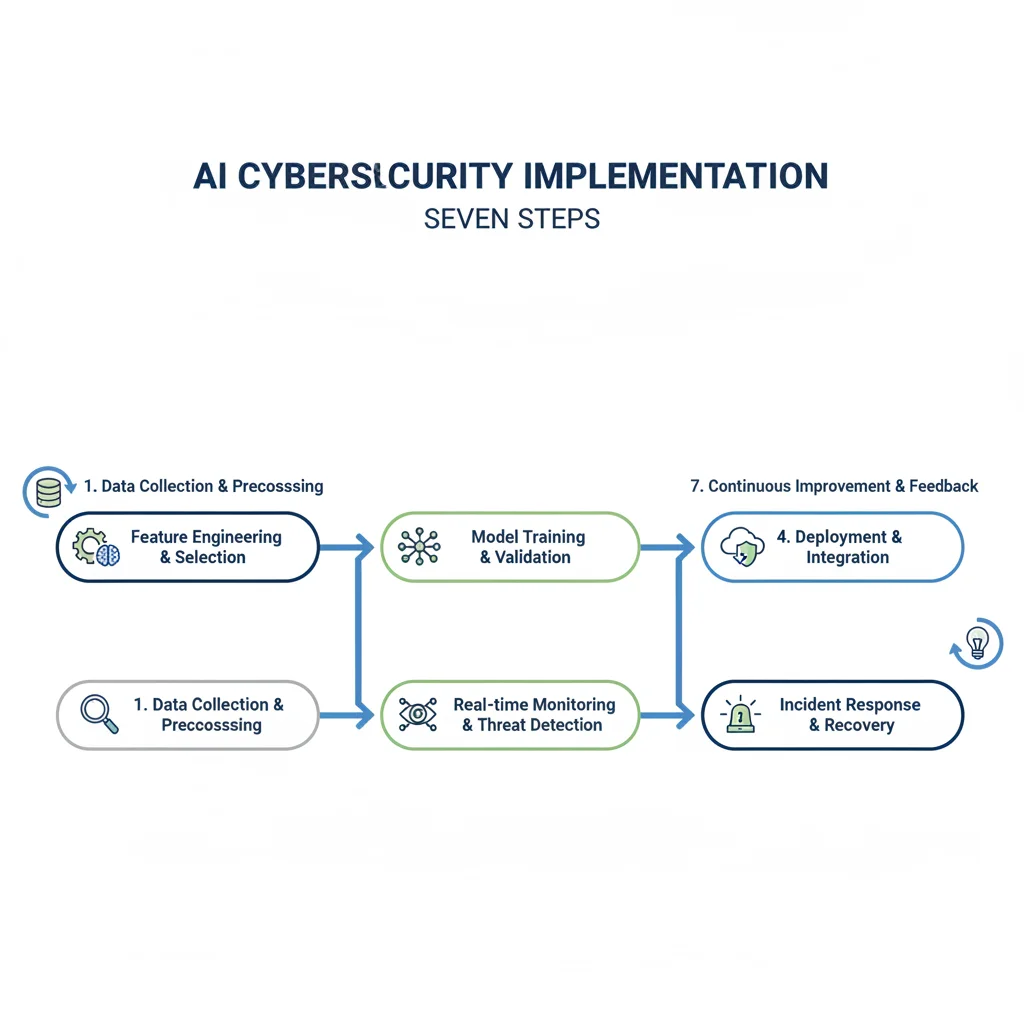
In today’s digital landscape, cyber threats are becoming increasingly sophisticated, making traditional security measures less effective. That’s where implementing AI for cybersecurity becomes crucial. Artificial intelligence offers powerful capabilities to detect, analyze, and respond to threats at a speed and scale impossible for human teams alone. This guide will walk you through a practical, 7-step process to integrate AI into your security operations, helping you achieve more proactive threat detection and a stronger defense posture.
By harnessing the power of AI, organizations can move beyond reactive security to anticipate and neutralize dangers before they cause significant damage. This proactive approach not only minimizes risk but also frees up security teams to focus on more complex strategic initiatives. Let’s explore how you can effectively bring AI into your cybersecurity framework.
Step 1: Assess Your Current Security Posture and Data Landscape
Before diving into AI tools, it’s essential to understand your existing security strengths and weaknesses. Begin by conducting a thorough audit of your current cybersecurity infrastructure, policies, and incident response procedures. Identify critical assets, potential vulnerabilities, and the types of threats your organization most commonly faces. This foundational understanding will guide your AI implementation strategy. Equally important is assessing your data landscape. AI systems thrive on data, so you need to know what security data you collect, where it resides, its quality, and its accessibility. This includes logs from firewalls, intrusion detection systems, endpoints, and cloud services. Understanding your data sources is the first step toward feeding your AI models effectively.
Step 2: Define Clear Objectives and Use Cases for AI
With an understanding of your current state, the next crucial step is to define what you want AI to achieve for your cybersecurity. Simply deploying AI without clear goals can lead to wasted resources. Think about specific pain points or areas where your current security operations struggle. Do you need faster detection of advanced persistent threats? Better anomaly detection in user behavior? Or perhaps more efficient vulnerability management? Clearly articulating these objectives will help you select the right AI technologies and measure their success. Focus on use cases that deliver tangible value and align with your overall security strategy. For example, a common goal is enhancing threat intelligence by using AI to process vast amounts of data more quickly.
Step 3: Select the Right AI Technologies and Tools
The market offers a wide array of AI-powered cybersecurity solutions, each with unique strengths. Choosing the right tools depends directly on the objectives you defined in the previous step. Some AI solutions specialize in network traffic analysis, using machine learning to spot unusual patterns indicative of an attack. Others focus on endpoint detection and response (EDR), leveraging AI to identify malicious processes or file changes. User and Entity Behavior Analytics (UEBA) tools use AI to establish baselines of normal behavior and flag deviations. Consider factors like ease of integration with your existing systems, scalability, vendor reputation, and ongoing support. It’s often beneficial to start with a pilot project using a tool that addresses a high-priority use case to gain experience before broader deployment.
Step 4: Data Collection, Preparation, and Feature Engineering
AI models are only as good as the data they’re trained on. This step involves gathering relevant security data from all identified sources. However, raw data is rarely ready for AI consumption. You’ll need to clean, normalize, and enrich this data. This means removing inconsistencies, standardizing formats, and adding context that helps the AI understand the information better. Feature engineering is a critical part of this process, where security experts transform raw data into features that AI algorithms can effectively learn from. For example, instead of just a timestamp, a feature might be ‘time of day’ or ‘frequency of login attempts within an hour’. High-quality, well-prepared data is fundamental for accurate AI threat detection and minimizing false positives.
Step 5: Model Training, Validation, and Deployment
Once your data is prepared, it’s time to train your AI models. This involves feeding the processed data to the chosen algorithms, allowing them to learn patterns associated with both normal and malicious activities. The training phase requires careful monitoring to ensure the model is learning effectively without overfitting or underfitting. After training, the model must be rigorously validated using a separate dataset to assess its performance, accuracy, and false positive rate. This validation helps fine-tune the model before it goes live. Finally, deploy the validated AI model into your production environment, integrating it with your existing security tools and workflows. This integration allows the AI to start actively monitoring, analyzing, and alerting on potential threats in real time.
Step 6: Integration with Existing Security Operations
Deploying AI models is just one part of the equation; seamless integration with your current security operations is paramount for success. AI should not operate in a silo. It needs to feed its insights and alerts into your Security Information and Event Management (SIEM) system, Security Orchestration, Automation, and Response (SOAR) platform, or other incident management tools. This ensures that AI-generated alerts are triaged, investigated, and acted upon by your human security team. Automated responses, where appropriate, can also be triggered based on AI detections, speeding up reaction times. Effective integration means your security analysts have a unified view of threats, combining AI’s analytical power with their expert judgment, leading to more efficient and effective incident response. This holistic approach strengthens your overall cyber defense.
Step 7: Continuous Monitoring, Feedback, and Improvement
The deployment of AI in cybersecurity is not a one-time project; it’s an ongoing process. Cyber threats constantly evolve, and so too must your AI models. Continuous monitoring of AI performance is crucial. Track key metrics like detection rates, false positive rates, and the time it takes to identify and respond to threats. Establish a feedback loop where security analysts can provide input on AI alerts, marking them as true positives or false positives. This human feedback is invaluable for retraining and refining your AI models. Regular updates, retraining with new data, and adapting to emerging threat landscapes ensure that your AI remains effective and relevant. This iterative approach to implementing AI for cybersecurity guarantees long-term value and enhanced protection.
Frequently Asked Questions
What is AI in cybersecurity?
AI in cybersecurity refers to the application of artificial intelligence and machine learning techniques to enhance an organization’s ability to prevent, detect, and respond to cyber threats. It automates threat analysis, identifies complex patterns, and predicts potential attacks more efficiently than traditional methods.
How does AI improve threat detection?
AI improves threat detection by analyzing vast amounts of data in real time, identifying anomalies, and recognizing patterns that indicate malicious activity. It can detect new, unknown threats (zero-day attacks) by learning from past incidents and continuously adapting to evolving attack methods, significantly reducing detection times.
Is AI a replacement for human security analysts?
No, AI is not a replacement for human security analysts. Instead, it serves as a powerful tool that augments their capabilities. AI handles repetitive tasks and processes massive datasets, allowing human analysts to focus on complex investigations, strategic planning, and decision-making that requires human intuition and judgment.
What are the challenges of implementing AI in cybersecurity?
Challenges include the need for high-quality, diverse training data, the complexity of integrating AI with existing systems, the potential for false positives, and the ongoing need for model maintenance and retraining. Additionally, skilled personnel are required to manage and interpret AI insights effectively.
How long does it take to implement AI for cybersecurity?
The timeline for implementing AI in cybersecurity varies widely depending on the organization’s size, existing infrastructure, and specific goals. A pilot project for a specific use case might take a few months, while a comprehensive, enterprise-wide deployment can span a year or more, involving continuous integration and refinement.
Implementing AI for cybersecurity is no longer a luxury but a necessity in the face of increasingly sophisticated cyber threats. By following this 7-step guide, organizations can systematically integrate artificial intelligence into their security operations, moving towards a more proactive and resilient defense posture. From assessing your current landscape and defining clear objectives to continuous monitoring and improvement, each step plays a vital role in building an effective AI-powered security framework.
The journey involves careful planning, strategic tool selection, meticulous data preparation, and seamless integration with human expertise. AI’s ability to analyze vast data sets, detect subtle anomalies, and automate responses empowers security teams to stay ahead of adversaries. Embrace this technological evolution to fortify your digital assets, reduce response times, and ultimately create a more secure environment for your organization. The future of cybersecurity is intelligent, adaptive, and proactive, driven by the strategic application of AI.