This article delves into HTTP/3 and its profound implications for web development by 2027. Discover how this new protocol enhances performance and reliability, and learn essential strategies for adapting your web projects to leverage its full potential.
By: pedropadm2025@gmail.com on agosto 14, 2026
The landscape of web development is constantly evolving, and a significant shift is underway with the adoption of HTTP/3. By 2027, this new protocol is expected to be a cornerstone of how data is transmitted across the internet, fundamentally changing how web applications are built and experienced. Understanding HTTP/3 and its implications is crucial for developers and businesses aiming to stay ahead in the digital realm.
HTTP/3 promises enhanced performance, improved security, and greater reliability, particularly for users on less stable network connections. This article will explore what makes HTTP/3 different, why its adoption is accelerating, and what steps you can take to prepare your web projects for this transformative change. Being proactive in embracing these new standards will ensure your applications remain fast, secure, and competitive in the coming years.
The Foundation of HTTP/3: Understanding QUIC
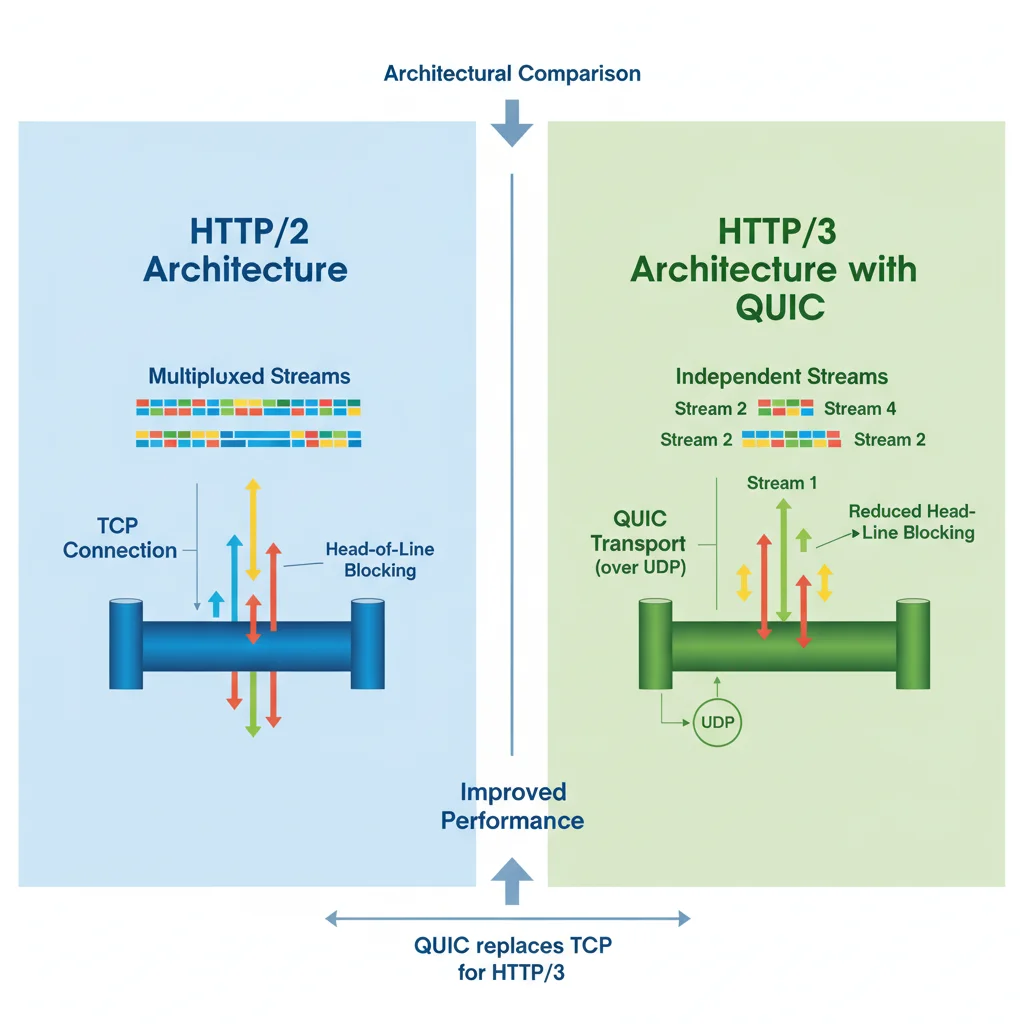
HTTP/3 represents a monumental leap forward from its predecessors, HTTP/1.1 and HTTP/2. The most significant change lies in its underlying transport protocol. Unlike previous HTTP versions that relied on TCP (Transmission Control Protocol), HTTP/3 is built on QUIC (Quick UDP Internet Connections). This fundamental shift addresses several long-standing limitations of TCP, particularly in areas like connection establishment and head-of-line blocking.
QUIC operates over UDP (User Datagram Protocol), which might seem counterintuitive given UDP’s connectionless nature. However, QUIC adds its own reliable stream multiplexing, flow control, and congestion control mechanisms on top of UDP. This combination allows for faster connection setup, as it can often establish a secure connection in zero or one round-trip time (0-RTT or 1-RTT), significantly reducing latency. This efficiency is especially beneficial for mobile users or those with high-latency connections, making web experiences feel much snappier.
The move to QUIC also means that individual streams within a single connection are independent. If one stream experiences packet loss, it doesn’t block other streams from progressing, a common issue known as head-of-line (HOL) blocking in TCP-based protocols. This resilience dramatically improves performance, especially in congested network environments. Developers need to grasp these core differences to fully leverage the benefits of HTTP/3 in their applications.
Key Performance Benefits for HTTP/3 Web Development
The adoption of HTTP/3 brings a suite of performance benefits that are vital for modern web applications. One of the most impactful advantages is the reduction in connection setup time. Traditional TCP and TLS handshakes can add significant latency, especially for new connections. QUIC, by integrating TLS 1.3 directly into its handshake, dramatically shortens this process, often allowing data to be sent immediately after the first client message. This ‘0-RTT’ connection establishment makes initial page loads noticeably faster.
Another crucial improvement is the elimination of head-of-line blocking at the transport layer. In HTTP/2, while multiple requests could be multiplexed over a single TCP connection, a lost packet for one stream would still hold up all other streams on that same connection until retransmission occurred. With QUIC, each stream is independent. If a packet for one stream is lost, only that specific stream is affected, allowing other streams to continue processing without interruption. This resilience leads to a more consistent and fluid user experience, particularly in challenging network conditions. These benefits make HTTP/3 a game-changer for web development, pushing the boundaries of speed and reliability.
Security Enhancements and Their Impact
Security has always been a paramount concern for web developers, and HTTP/3 takes significant strides in this area. One of the most notable security enhancements is the mandatory use of TLS 1.3. Unlike previous versions where TLS could be optionally layered on top of TCP, QUIC bakes TLS 1.3 directly into its design. This means that all HTTP/3 connections are encrypted by default, making it much harder for attackers to eavesdrop on or tamper with data in transit. This mandatory encryption provides a higher baseline of security for all web communication.
Furthermore, QUIC’s design makes it more resistant to certain types of network attacks. For instance, its connection IDs allow clients to roam between different IP addresses and network interfaces without dropping the connection. This feature, while primarily for mobility, also makes it more challenging for attackers to hijack sessions based on IP changes. The integrated encryption and improved connection handling contribute to a more robust and secure web environment. Developers can build applications with greater confidence, knowing that the underlying transport layer provides strong security guarantees. Adopting HTTP/3 means automatically upgrading to a more secure communication standard, which is a significant advantage for protecting user data and maintaining trust.
Challenges and Considerations for Adoption
While the benefits of HTTP/3 are compelling, its widespread adoption also comes with a set of challenges and considerations that developers and organizations need to address. One primary hurdle is the current state of infrastructure support. While major browsers and content delivery networks (CDNs) are increasingly supporting HTTP/3, older network equipment, firewalls, and load balancers may not yet be configured to handle QUIC traffic efficiently, or they might even block UDP traffic on port 443 by default. This can lead to fallback mechanisms to HTTP/2 or HTTP/1.1, negating some of the performance gains.
Technical Adjustments for Developers
Server Configuration: Ensure your web servers (e.g., Nginx, Apache, Caddy) are updated and correctly configured to enable HTTP/3 support. This often involves specific modules or build flags.
Monitoring and Debugging: Debugging QUIC-based connections can be more complex than TCP. Developers will need new tools and techniques to monitor and troubleshoot HTTP/3 traffic effectively.
Library and Framework Updates: Backend frameworks and client-side libraries might require updates to fully support and leverage HTTP/3 features, although many changes are transparent at the application layer.
Overcoming these challenges requires careful planning, testing, and collaboration between development teams and network operations. As 2027 approaches, these considerations will become increasingly critical for seamless integration.
Preparing Your Web Projects for HTTP/3 by 2027
The transition to HTTP/3 is not a matter of if, but when. Proactive preparation is key to ensuring your web projects are ready to fully capitalize on its advantages by 2027. The first step involves assessing your current infrastructure. Check if your hosting provider or CDN offers HTTP/3 support and understand how to enable it. Many leading CDNs already provide this, making the transition relatively straightforward for many.
Next, focus on updating your server software. Modern versions of popular web servers like Nginx and Caddy have robust HTTP/3 implementations. Regularly updating these components and configuring them correctly is crucial. Developers should also start familiarizing themselves with QUIC and how it impacts network performance. While much of the protocol operates below the application layer, understanding its characteristics will help in optimizing resource loading and error handling.
Finally, consider implementing robust monitoring and analytics that can differentiate between HTTP/2 and HTTP/3 traffic. This will allow you to track the real-world performance benefits and identify any potential issues that arise during the transition. Gradual testing and rollout, starting with a subset of users or specific environments, can help smooth the adoption process and ensure a seamless experience for your users as HTTP/3 becomes the dominant web protocol.
Frequently Asked Questions
What is the main difference between HTTP/2 and HTTP/3?
The core difference is the transport protocol. HTTP/2 uses TCP, while HTTP/3 is built on QUIC, which runs over UDP. This change allows HTTP/3 to offer faster connection setup and eliminate head-of-line blocking at the transport layer, improving performance and reliability.
Will I need to rewrite my entire application for HTTP/3?
Generally, no. HTTP/3 operates at a lower layer than most application code. While server configurations and potentially some network libraries might need updates, the application logic itself should largely remain compatible. The benefits are often realized without extensive code changes.
How does HTTP/3 improve security?
HTTP/3 mandates the use of TLS 1.3, integrating encryption directly into the QUIC protocol. This ensures all HTTP/3 connections are encrypted by default, enhancing data privacy and integrity compared to earlier HTTP versions where TLS was an optional layer.
What is head-of-line blocking and how does HTTP/3 solve it?
Head-of-line blocking occurs when the loss of a single packet on a connection delays the processing of all subsequent packets, even if they belong to different streams. HTTP/3’s QUIC protocol solves this by allowing independent streams within a single connection, so a lost packet on one stream doesn’t affect others.
When can I expect HTTP/3 to be fully adopted?
While adoption is ongoing, major browsers and CDNs already support HTTP/3. By 2027, it is widely anticipated that HTTP/3 will be a dominant protocol for web traffic, making it essential for developers to ensure their systems are compatible and optimized.
The evolution to HTTP/3 marks a pivotal moment in web development, promising a faster, more secure, and more reliable internet experience. By leveraging QUIC, HTTP/3 addresses fundamental limitations of older protocols, offering significant performance gains through quicker connection establishments and the elimination of head-of-line blocking. Its mandatory integration of TLS 1.3 also elevates the baseline for web security, protecting user data more effectively than ever before.
While the transition presents challenges, such as ensuring infrastructure compatibility and updating server configurations, the benefits far outweigh the complexities. As we approach 2027, proactive preparation is not just recommended but essential for developers and businesses. Embracing HTTP/3 will ensure your web applications remain competitive, deliver superior user experiences, and are future-proofed against the ever-increasing demands of the digital world. The future of the web is fast, secure, and built on HTTP/3, and now is the time to get ready.