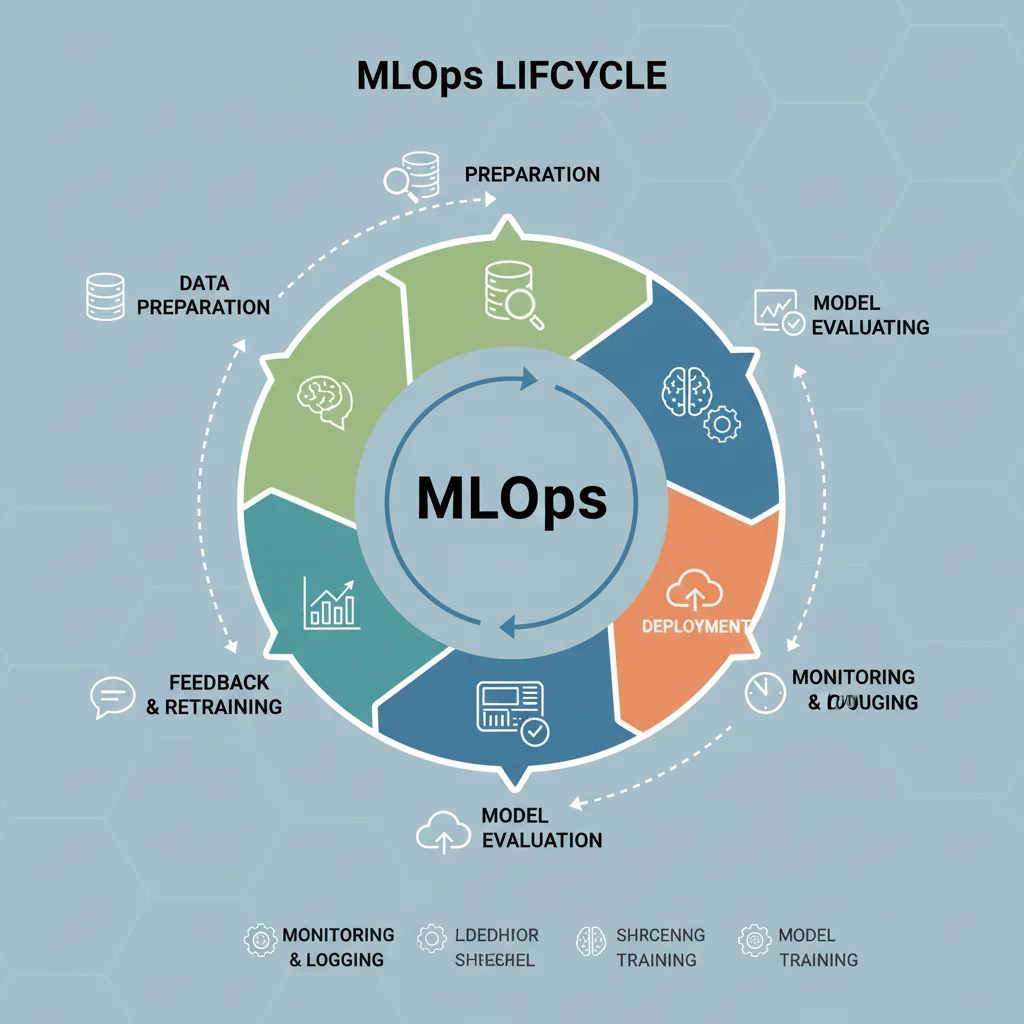
This article provides a comprehensive 6-month MLOps implementation roadmap, guiding organizations through the essential steps to successfully integrate machine learning operations. Learn about planning, tooling, deployment, and monitoring to optimize your AI initiatives.
Por: Michael Sete em 21 de agosto de 2026
Última atualização em: agosto 24, 2026
In today’s fast-evolving technological landscape, businesses are increasingly leveraging machine learning to drive innovation and gain a competitive edge. However, moving machine learning models from development to production and maintaining them effectively can be a complex challenge. This is where Machine Learning Operations, or MLOps, comes into play, offering a structured approach to streamline the entire ML lifecycle. A well-defined MLOps implementation roadmap is crucial for organizations looking to integrate these practices smoothly and efficiently.
This guide will demystify the process, providing a practical 6-month implementation roadmap designed to help your team successfully adopt MLOps principles. We’ll break down the journey into manageable phases, ensuring a clear path from initial planning to robust model deployment and continuous monitoring. By following this roadmap, you can transform your ML initiatives from experimental projects into reliable, scalable, and impactful solutions that deliver real business value.
Month 1: Assessment and Strategy Definition
The first month of any MLOps implementation roadmap is all about understanding your current state and setting a clear direction for the future. Before diving into tools or processes, it’s essential to thoroughly assess your existing machine learning workflows, infrastructure, and team capabilities. This initial assessment helps identify bottlenecks, inefficiencies, and areas where MLOps can provide the most significant benefits. It’s also the time to define specific, measurable goals for your MLOps adoption, ensuring everyone is aligned on what success looks like.
During this phase, engage with key stakeholders from data science, engineering, and business units. Their input is invaluable for understanding diverse needs and potential challenges. Documenting current model development, deployment, and monitoring practices will provide a baseline for future improvements. This foundational work ensures that the subsequent months are built on a solid understanding of your organization’s unique requirements and aspirations. Without a clear strategy, even the best tools and intentions can fall short.
Key Activities for Month 1
Current State Analysis: Evaluate existing ML pipelines, data management, model training, and deployment methods. Identify pain points and manual processes.
Goal Setting: Define clear, measurable objectives for MLOps implementation, such as reducing deployment time, improving model reliability, or enhancing collaboration.
Stakeholder Alignment: Conduct workshops and meetings with data scientists, ML engineers, DevOps teams, and business leaders to gather requirements and build consensus.
Tooling Exploration (Initial): Begin researching potential MLOps tools and platforms that align with your existing tech stack and future needs, without making final decisions yet.
By the end of Month 1, your team should have a comprehensive understanding of where you stand and a well-defined strategy for where you want to go. This strategic foundation is critical for the smooth progression of your MLOps journey, laying the groundwork for effective tool selection and process design in the months to come. It’s a critical step in any successful MLOps implementation roadmap.
Month 2-3: Infrastructure Setup and Tooling Selection
After a thorough assessment and strategic planning, months two and three focus on building the foundational infrastructure and selecting the right MLOps tools. This period is crucial for establishing a robust environment that can support the entire machine learning lifecycle, from data ingestion to model serving. The choices made here will significantly impact the scalability, efficiency, and maintainability of your MLOps pipeline. It’s not just about picking popular tools, but rather selecting those that best fit your organization’s specific needs, existing technology stack, and team’s skill set.
Begin by setting up a dedicated environment for MLOps development and testing. This might involve configuring cloud resources, establishing version control for code and models, and setting up centralized artifact repositories. The goal is to create a standardized and reproducible environment where models can be developed, trained, and deployed consistently. Evaluating different MLOps platforms and tools based on your Month 1 requirements is key. Consider factors like ease of integration, cost, community support, and features such as experiment tracking, model registry, and automated deployment capabilities.
It’s important to approach tooling selection with a pragmatic mindset. Sometimes, a combination of open-source tools and managed services can offer the most flexible and cost-effective solution. Pilot projects with a few chosen tools can provide valuable insights into their suitability before making a full commitment. Documenting your infrastructure choices and tool configurations is also vital for future maintenance and onboarding new team members. This phase directly influences the efficiency of your MLOps implementation roadmap.
Establishing this robust infrastructure is not a one-time task; it requires continuous refinement. However, getting the core components right in these initial months sets the stage for smoother operations later on. Focus on creating a scalable and secure environment that can grow with your machine learning initiatives. This careful planning and execution in infrastructure setup and tooling selection will pay dividends, making the subsequent phases of your MLOps implementation roadmap much more manageable and effective.
Month 4: Pipeline Automation and CI/CD Integration
With the infrastructure in place and initial tools selected, Month 4 shifts focus to automating the machine learning pipeline and integrating Continuous Integration/Continuous Delivery (CI/CD) principles. This is where the true power of MLOps begins to manifest, transforming manual, error-prone processes into efficient, automated workflows. The core idea is to create a seamless flow from code changes to model deployment, ensuring consistency, speed, and reliability. Automation reduces human error and frees up data scientists and engineers to concentrate on more complex, value-adding tasks.
Start by automating the data ingestion and preprocessing steps. This involves setting up data pipelines that automatically pull, clean, and transform data, making it ready for model training. Next, focus on automating the model training process. This includes versioning datasets, tracking experiments, and automatically retraining models when new data becomes available or performance degrades. Integrating these steps with a CI/CD system means that any code changes, data updates, or model improvements can trigger an automated build, test, and deployment process. This ensures that models in production are always up-to-date and performing optimally.
The integration of CI/CD also extends to model testing. Automated tests should verify model performance, data drift, and potential biases before a model is deployed. This crucial step acts as a safeguard, preventing underperforming or problematic models from reaching production. Establishing clear triggers for pipeline execution, whether it’s a code commit, a scheduled event, or a data update, is fundamental. This automation significantly shortens the feedback loop, allowing teams to iterate faster and respond quickly to changes in data or business requirements. This month is pivotal for solidifying the MLOps implementation roadmap.
Successfully implementing pipeline automation and CI/CD integration requires close collaboration between data scientists and ML engineers. Data scientists bring their expertise in model development, while ML engineers ensure the robustness and scalability of the automated pipelines. This synergy is vital for building a mature MLOps practice that can continuously deliver high-quality machine learning models. By the end of this month, your MLOps pipeline should be largely automated, ready for more advanced deployment strategies.
Month 5: Model Deployment and Serving Strategies
Month 5 of the MLOps implementation roadmap is dedicated to refining model deployment and serving strategies. Having established automated pipelines, the next critical step is to ensure that trained models can be reliably and efficiently deployed into production environments and made accessible for real-time predictions or batch processing. This phase involves selecting appropriate deployment patterns, implementing robust serving infrastructure, and setting up effective versioning and rollback mechanisms. The goal is to move models from the experimental stage to a state where they are actively generating business value.
Consider different deployment strategies based on your application’s requirements. For real-time inference, options like REST APIs or serverless functions might be suitable, while batch predictions might leverage scheduled jobs or distributed computing frameworks. Implementing a model registry is crucial here, serving as a centralized hub to store, version, and manage all trained models. This registry allows for easy tracking of model metadata, performance metrics, and lineage, making it simple to select the correct model version for deployment and to roll back to previous versions if issues arise. This is a key component of a successful MLOps implementation roadmap.
Furthermore, setting up A/B testing or canary deployments during this month allows for careful evaluation of new model versions in a production setting without impacting all users. This controlled rollout minimizes risks and provides valuable feedback on model performance in the real world. Securely serving models also means implementing authentication, authorization, and network security measures to protect sensitive data and prevent unauthorized access. Scalability is another vital consideration; ensure your serving infrastructure can handle varying loads and can be easily scaled up or down as demand changes.
The successful implementation of these deployment and serving strategies ensures that your machine learning models are not just developed but are also effectively delivering predictions and insights to end-users. This phase transforms theoretical models into practical assets, directly contributing to business outcomes. A well-executed Month 5 means your MLOps implementation roadmap is nearing completion, with models actively in use and generating value.
Month 6: Monitoring, Feedback Loops, and Continuous Improvement
The final month of our 6-month MLOps implementation roadmap focuses on establishing robust monitoring, creating effective feedback loops, and fostering a culture of continuous improvement. Deploying a model is not the end of the MLOps journey; it’s merely the beginning of its operational life. Models, like any software, require ongoing attention to ensure they perform as expected in dynamic real-world environments. This phase is critical for maintaining model health, detecting performance degradation, and ensuring long-term value generation.
Implement comprehensive monitoring solutions that track key model performance metrics, such as accuracy, precision, recall, and F1-score, in real-time. Beyond performance, monitor for data drift (changes in input data distribution) and concept drift (changes in the relationship between input and output variables), which can significantly impact model effectiveness over time. Set up alerts to notify your team immediately when deviations or performance drops are detected, allowing for proactive intervention. This proactive monitoring is a cornerstone of any effective MLOps implementation roadmap.
Establishing clear feedback loops is equally important. This involves collecting feedback from model predictions, whether it’s user feedback on recommendations or expert review of classifications. This feedback can then be used to retrain and improve models, closing the loop in the iterative MLOps cycle. Documenting these feedback mechanisms and integrating them back into your automated pipelines ensures that model improvements are systematically captured and implemented. This continuous learning process is what truly differentiates a static ML deployment from a dynamic, evolving MLOps system.
Finally, Month 6 is about institutionalizing a culture of continuous improvement. Regularly review your MLOps processes, tools, and team collaboration. Conduct post-mortems for any model failures or performance issues to learn from them and refine your workflows. Encourage experimentation with new techniques and technologies to keep your MLOps practice cutting-edge. This commitment to ongoing refinement ensures that your MLOps implementation remains effective, scalable, and adaptable to future challenges. By embracing continuous improvement, your organization will unlock the full potential of its machine learning investments.
Frequently Asked Questions
What is MLOps and why is it important for businesses?
MLOps, or Machine Learning Operations, is a set of practices that combines Machine Learning, DevOps, and Data Engineering to streamline the entire ML lifecycle, from development to deployment and maintenance. It’s crucial for businesses because it enables faster model deployment, improves model reliability, ensures scalability, and facilitates continuous improvement of ML applications, ultimately driving better business outcomes.
How long does a typical MLOps implementation take?
The duration of an MLOps implementation can vary significantly based on an organization’s size, existing infrastructure, and the complexity of its machine learning initiatives. However, a structured approach like the 6-month MLOps implementation roadmap discussed in this article provides a realistic timeline for establishing core MLOps capabilities and seeing tangible results.
What are the biggest challenges in adopting MLOps?
Common challenges in MLOps adoption include cultural shifts within teams, lack of skilled personnel, integrating diverse tools, ensuring data quality and governance, and managing model versioning and lineage. Overcoming these requires a clear strategy, strong leadership, and continuous training.
Can MLOps be implemented with open-source tools?
Yes, MLOps can absolutely be implemented using a combination of open-source tools. Many organizations leverage open-source solutions for experiment tracking (e.g., MLflow), version control (e.g., Git), orchestration (e.g., Kubeflow), and monitoring (e.g., Prometheus and Grafana) to build their MLOps pipelines cost-effectively.
What roles are essential for an MLOps team?
An effective MLOps team typically includes Data Scientists (for model development), ML Engineers (for pipeline automation and deployment), DevOps Engineers (for infrastructure and CI/CD), and Data Engineers (for data pipelines and governance). Collaboration among these roles is key to successful MLOps implementation.
Embarking on an MLOps journey is a strategic imperative for any organization serious about leveraging machine learning for sustained business growth. This 6-month MLOps implementation roadmap provides a structured, actionable guide to help you navigate the complexities of operationalizing ML models. From initial assessment and strategic planning to infrastructure setup, pipeline automation, robust deployment, and continuous monitoring, each phase builds upon the last to create a resilient and efficient ML ecosystem.
By systematically addressing each stage, teams can overcome common hurdles, foster better collaboration between data scientists and engineers, and significantly reduce the time and effort required to bring models to production. The ultimate goal is not just to deploy models, but to ensure they deliver consistent value, adapt to changing data landscapes, and remain reliable over their operational lifespan. Adopting MLOps is an investment in the future of your AI initiatives, transforming them from isolated projects into a powerful, integrated capability that drives innovation and competitive advantage. Start your MLOps journey today, and unlock the full potential of your machine learning investments.